How the airline sim works: from city demand to profit
You found a carrier in a shared world, then win passengers who start in real cities and regions. The steps below are the whole loop, from the free account to the books at the end of a game day.
Demand comes first
Chief Airline Officer does not hand you a pile of passengers already standing at an airport. Demand is built from 21,000+ real cities and regions worldwide (all 3,222 US counties from Census data). Canada uses census divisions, Mexico uses municipios, and the rest of the world uses GeoNames cities plus leftover admin-1 regions. Travelers choose among nearby airports by travel time.
Each origin can consider up to 10 airports. Travel time is a straight-line estimate, capped at about 165 minutes, so a field that sits far outside that window is simply not in the choice. Business, leisure, and visiting-friends-and-relatives travelers weigh the same trip differently. A cheaper fare can pull a leisure traveler toward a more distant airport. A business traveler is less willing to spend that time.
After a traveler picks a destination, the itinerary is a complete offer: origin airport, airline, fare, schedule, and whether the trip is nonstop or a connection. A one-stop exists only when two real flights meet at a hub, flown by the same airline or by alliance partners. That is how a new hub can win a city pair nobody serves nonstop.
1. Create a free account
Registration is open in the browser. There is nothing to install on desktop or mobile. You join a world that other people can join too. The published game is multiplayer: you share passengers, airports, and the clock with the other airlines in that world.
Worlds keep their calendar. If you arrive after the first day, you play the current game date. The clock does not rewind to give a late airline a private head start.
2. Found your airline
Name the carrier and start with $25 million, the same starter cash as every other new airline. You open from a headquarters and can add a base later. Cash, fleet, and routes belong to that airline. Another carrier on the same account does not inherit this airline's books.
The first routes are a bet on the cities around the airport you picked. A secondary field can win travelers who would rather not spend the extra travel time to reach a bigger hub. A famous hub can win on schedule and connections, and it also puts you next to whoever else already flies there.
3. Build a fleet and a product
Aircraft come from four places: a new order, the used market, a lease, or a financed purchase. A used asking price steps down the longer that listing sits unsold, down to a floor. You choose a cabin layout before the airplane is doing useful work. The livery studio, which paints fuselage, tail, and engines, is one of the optional credit tools. Flying the airplane is not.
Age is an operating fact. As an airframe gets older it costs more to crew and maintain, and dispatch reliability falls. Fuel burn on the listing stays the catalog figure. At 40 years the airframe has to leave the fleet. Range and seats come from the aircraft type, so a new regional jet is not a substitute for a long-haul airplane just because it is new.
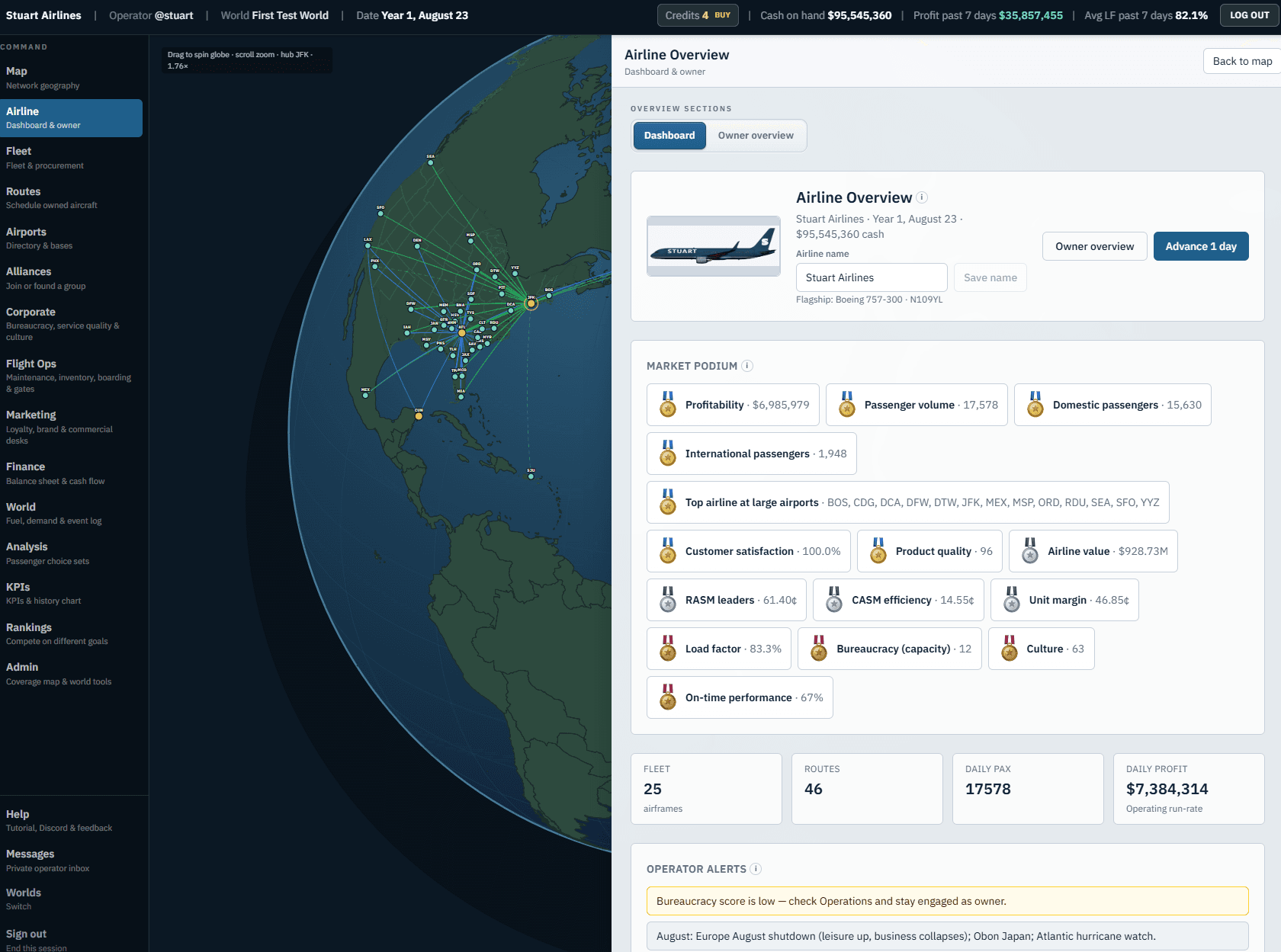
4. Open routes and take the choice
Pick a city pair, set the fare and the frequency, and assign an aircraft that can fly it. Passengers compare your offer with every other legal offer in the same choice, including a rival nonstop and a connection over someone else's hub. You either win the boarding or you do not. Airport capacity is part of that world: gates and slots are finite, so a busy field is not an unlimited departure board.
Route analysis, the screen that lines up rival fares and how passengers split between nonstop and connecting trips, costs one optional credit. The underlying choice model runs either way. The credit does not add passengers, and it does not change the score.
5. Let the clock and the books move
One in-game day advances about every 45 real minutes, including while you are signed out. A game month is 30 game days, about 22.5 real hours. Fares and schedules you already filed keep operating. The point of the cadence is that you can check in a few times a day and still find that the market has moved.
Fuel prices and interest rates move with the economy. The same simulation can throw a fuel spike, a pandemic, or a war. A corporate loan is available when the desk will still lend. If cash cannot cover lease or finance payments, payroll, and gate fees, a 90-game-day insolvency clock starts. Restoring that coverage stops the clock. Leaving it does not.
Culture, on-time performance, and alliances sit on top of the same books. Founding an alliance costs one credit. Joining an alliance that already exists is free. Partners matter because a connection can be built from their flights as well as yours.
What you can read next
The feature list is the short map of systems. The FAQ answers the free-to-play, credit, and clock questions one at a time. The airline management game page puts this loop next to other published airline games, and the roundup lists those games on their own pages' terms.